Wondering how the Alhambra fits together? Alhambra architecture history comes in layers: Nasrid rulers began this Granada palace city in 1238, and Charles V added a Renaissance palace in 1526.
This guide sits within the wider story of spanish architecture.
| Item | Value |
|---|---|
| Construction begun | 1238, by Muhammad I Ibn al-Ahmar |
| Christian conquest of Granada | 1492 |
| Charles V commissions his palace | 1526 |
| UNESCO World Heritage designation | 1984 |
| Size of the complex | Nearly 26 acres, more than a mile of walls, 30 towers |
The dates come from Wikipedia’s Alhambra entry and the size from the HISTORY.com Alhambra article. Figures can change as research is updated, so check the source before you rely on them.
A palace city above Granada
The Alhambra is a palace and fortress complex in Granada, built on Sabika hill, an outcrop of the Sierra Nevada that had already hosted earlier fortresses and the 11th-century palace of Samuel ibn Naghrillah, as Wikipedia explains. Its name comes from the Arabic al-qal’a al-hamra, which HISTORY.com translates as red fort or castle.
During the Nasrid era it worked as a self-contained city, separate from the rest of Granada below. Wikipedia lists these amenities:
- A Friday mosque and hammams (public baths)
- Roads and houses
- Artisan workshops and a tannery
- A sophisticated water supply system
The same source counts at least six major palaces, most of them along the northern edge where they commanded views over the Albaicín quarter. HISTORY.com divides the complex into three main sections:
- The Alcazaba, a military base that housed guards and their families
- The palatial zone, with several palaces for the sultan and his kin
- The Medina, a quarter where court officials lived and worked
How the Nasrid rulers built it
Building began in 1238, when Muhammad I Ibn al-Ahmar, the first Nasrid emir and founder of the Emirate of Granada, started the complex, according to Wikipedia. Later Nasrid rulers kept modifying the site.
Muhammad I laid the foundations by fortifying the royal site. HISTORY.com credits him with these works:
- Three new towers for the Alcazaba: the Broken Tower, the Keep and the Watch Tower
- Canalizing water from the Darro River
- Halls for soldiers and younger guards, and the start of the palaces and ramparts
No single ruler finished the job. The most significant campaigns took place in the 14th century under Yusuf I and Muhammad V, and they gave the royal palaces much of their defining character, says Wikipedia.
Most of the well-known structures date to those two rulers, according to HISTORY.com:
- The Patio of the Lions
- The Justice Gate and the Baths
- The Comares Room and the Hall of the Boat
Courtyards, stucco and the palace layout
The architecture of the Nasrid palaces reflects the Moorish tradition developed over previous centuries, as Wikipedia puts it. The wider tradition is covered in the guide to moorish architecture in spain.
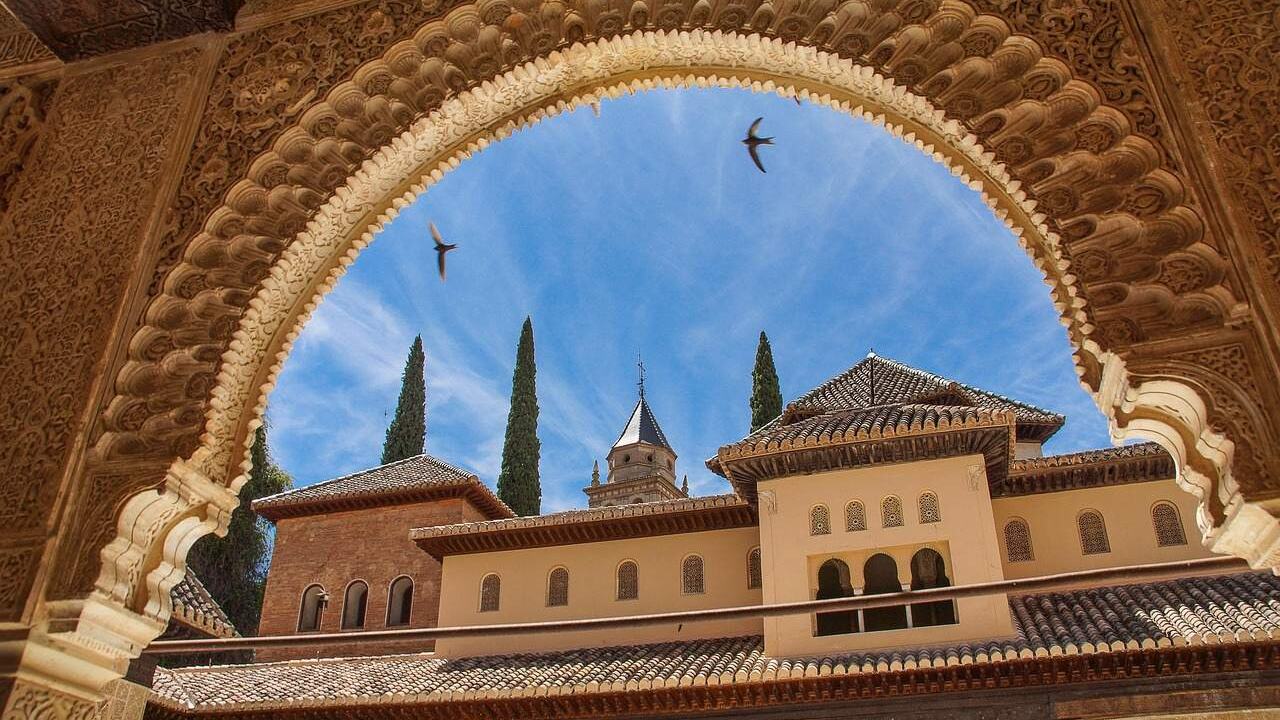
The courtyard is the central idea: it was the basic unit around which halls and rooms were organised, usually with a reflective pool or a fountain at its centre. Decoration stayed on the inside, mainly as tile mosaics on lower walls and carved stucco on the upper walls (Wikipedia).
HISTORY.com describes the Nasrid palaces as three independent areas:
- The Mexuar, a semipublic part for justice and state affairs
- The Comares Palace, the official residence of the sultan, arranged around the Court of the Myrtles
- The Palace of the Lions, a private area for the king and his family
The two best-known courtyards show the water-and-arcade formula. The Court of the Myrtles has a large central pond lined with myrtle bushes, and the Lions fountain is surrounded by twelve lions (HISTORY.com). The Court of the Lions itself is an arcaded patio supported by 124 columns, according to Saga.
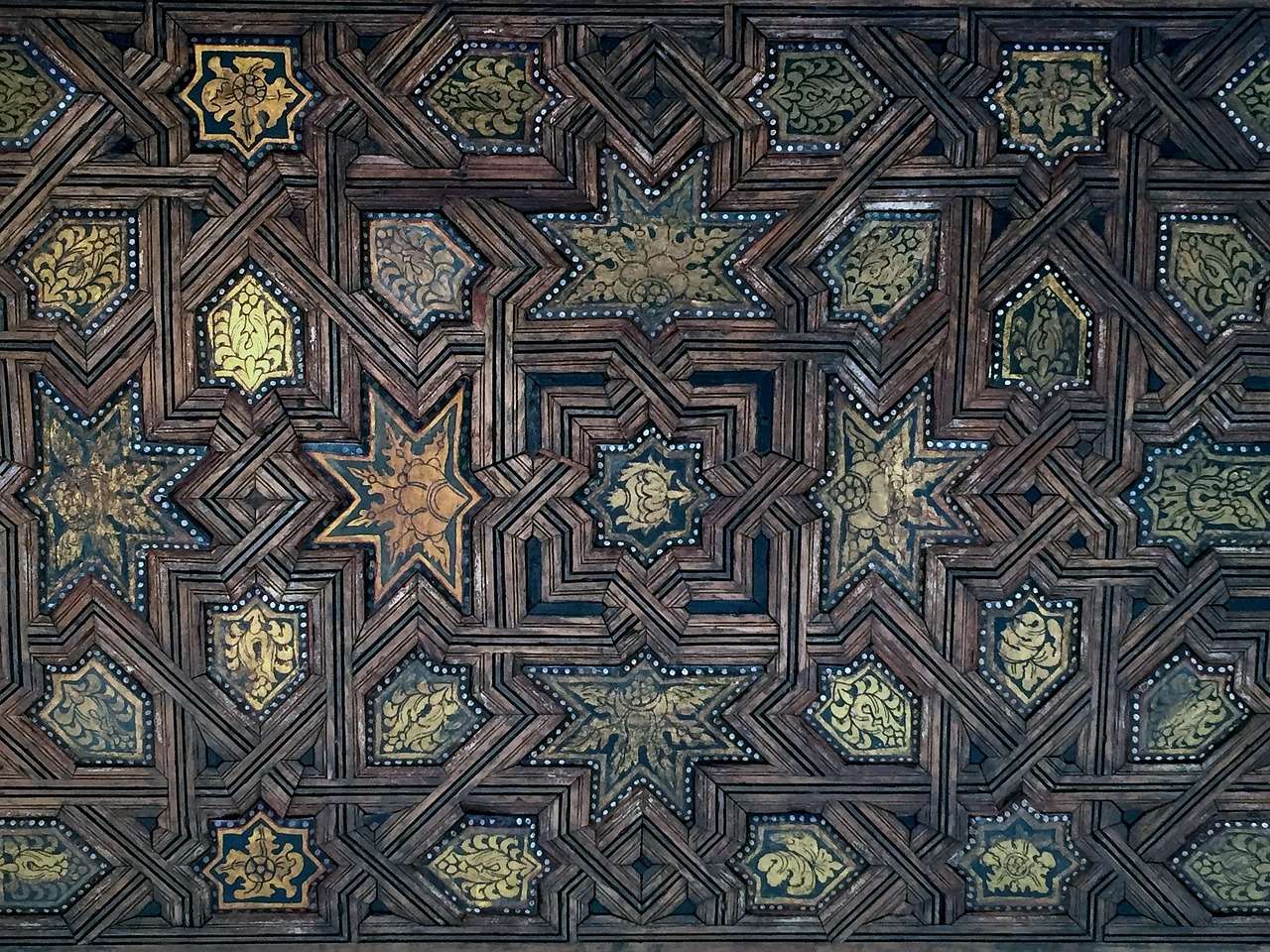
Inside the halls, ceilings do much of the work. The Hall of the Abencerrajes has a stalactite ceiling, and the Hall of the Ambassadors was a chamber where emirs negotiated with Christian emissaries (HISTORY.com).
The Alcazaba, the Generalife and the water
The Alcazaba is the oldest part of the Alhambra, a fortress with multiple towers at the complex’s western tip. HISTORY.com notes that experts believe it was built before Muslims arrived in Granada, though the Nasrids fortified it as a base for the royal guard.
Saga adds that it served as the royal residence until the palaces were built in the 14th century, after which it continued as a military compound (Saga).
The Generalife lies outside the walls, nearby to the east. Wikipedia calls it a former Nasrid country estate and summer palace with historic orchards and modern landscaped gardens. Saga describes its basic layout as a Charbagh, with four quadrants traditionally created by water channels.
Water ran through the whole site. Wikipedia lists a sophisticated water supply system among the city’s amenities, and HISTORY.com says Muhammad I canalized water from the Darro River.
From Christian court to restored monument
After the Christian Reconquista concluded in 1492, the site became the Royal Court of Ferdinand and Isabella. In 1526, Charles V commissioned a Renaissance-style palace right beside the Nasrid palaces (Wikipedia).
HISTORY.com says Charles V ordered part of the complex destroyed to make room for it. Saga adds that this addition was never finished, though it remains an interesting example of Renaissance architecture.
In the following centuries the Alhambra fell into disrepair, with its buildings occupied by squatters, and the troops of Napoleon destroyed parts of it in 1812. Romantic travellers then rediscovered it, above all Washington Irving, whose Tales of the Alhambra (1832) brought international attention to the site (Wikipedia).
Numerous restorations have followed since the 19th century, according to Wikipedia. UNESCO designated the Alhambra in 1984 together with the Albaicín and the Generalife Garden, as HISTORY.com reports.
For how Spanish building traditions travelled further afield, read the guide to spanish colonial architecture.
Frequently asked questions
Who built the Alhambra?
Show answer
No single ruler did. Muhammad I began the complex in 1238, and later Nasrid rulers continued the work, according to Wikipedia.
What does the name Alhambra mean?
Show answer
The Arabic al-qal’a al-hamra means red fort or castle, as HISTORY.com explains.
What is the oldest part of the Alhambra?
Show answer
The Alcazaba, a fortress with multiple towers, is the oldest part, says HISTORY.com.
When did the Alhambra become a UNESCO site?
Show answer
It was designated in 1984, together with the Albaicín and the Generalife Garden (HISTORY.com).
How long does a visit take?
Show answer
A visit usually lasts around 3 hours, according to History Hit. Check the official visitor information before you plan your day.