Trying to make sense of Spanish architecture? Think of it as layers: Roman engineering, Islamic geometry, Gothic cathedrals, Gaudí’s Modernisme and Gehry’s titanium Bilbao, each shaped by the era and region that built it.
| Item | Key fact |
|---|---|
| Spain’s rank for UNESCO World Heritage Sites | Third highest in the world (only Italy and China have more) |
| Muslim conquest of Iberia | 711 CE |
| Cueva de Menga dolmen, Antequera | 25 metres deep, 4 metres high, 32 megaliths |
| Aqueduct of Segovia | 167 arches |
| Fall of Granada | 1492 |
| Guggenheim Bilbao completed | 1997 |
These figures come from Wikipedia’s Spanish architecture article (its citations notice is dated April 2022) and a Sotheby’s Realty journal guide. Figures and rankings can change, so check the source before you rely on them.
Prehistory and Roman Hispania: the first layers
Wikipedia defines Spanish architecture as architecture in any area of what is now Spain, and by Spanish architects worldwide, influencing mainly areas of what was once part of the Spanish Empire. That wide definition also takes in buildings from before Spain existed as a nation, when the land was called Iberia, Hispania, or was divided between several Christian and Muslim kingdoms.
The result is great historical and geographical diversity, depending on the period. The same page says Spanish building developed along lines similar to other Mediterranean, Central European and Northern European styles, although some Spanish constructions are unique.
This guide follows the story in order, from Stone Age tombs to titanium curves, and points you to deeper pieces on each major style.
Megaliths, islands and hilltop villages
In the Stone Age the most common megalith in the Iberian Peninsula was the dolmen, a funerary chamber of huge stones set in the ground with others laid over them as a roof. As the type evolved, an entrance corridor appeared and gradually became almost as wide as the chamber.
The complex of Antequera contains the largest dolmens in Europe, according to Wikipedia. The best preserved, the Cueva de Menga, is 25 metres deep and 4 metres high, and was built with 32 megaliths. The Sotheby’s Realty guide also describes 32 massive stone slabs, calling it early engineering at scale.
The best preserved Bronze Age architecture is in the Balearic Islands, where three kinds of construction appeared:
- Taula: a T-shaped monument.
- Talayot: a defensive tower, which used to have a central pillar.
- Naveta: a building of great stones shaped like a ship hull.
The most characteristic Celtic constructions were the castros, walled villages usually on the top of hills or mountains. Per Wikipedia, the houses inside were about 3.5 to 5 metres long, mostly circular, built of stone with thatch roofs resting on a central wooden column.
Their streets were somewhat regular, which suggests some form of central organization. Some towns related to Iberian culture reached notable urban development, such as Numantia.
The Roman imprint
The Roman conquest, started in 218 BC, promoted the almost complete romanization of the Iberian Peninsula, as Wikipedia puts it. The Romans left behind some of their most outstanding monuments in Hispania.
The Sotheby’s guide describes cities shaped by grids and forums, with aqueducts, bridges and civic buildings linking Spain into imperial networks. Stone quickly became the dominant building material, a sign of the rationality and durability of Roman design.
The Aqueduct of Segovia is the showpiece. It was built across Castile and León in the first century CE, and its 167 arches of precision-cut granite blocks made an imposing feature on the landscape, as Sotheby’s Realty notes.
Roman remains are everywhere. The Wikipedia article pictures the Roman theatre in Mérida, and Scholastic’s art guide says remains of Roman walls, bridges and aqueducts can be found in every corner of Spain.
The Visigoths who followed brought what Wikipedia calls a profound decline in building techniques, paralleled in the rest of the former Roman Empire. Scholastic judges their contribution to the arts limited, yet they introduced the horseshoe arch, which would become a basic element in later Spanish architecture.
Al-Andalus and the Mudéjar blend
The Muslim conquest in 711 CE led to a radical change, and for the following eight centuries there were great advances in culture, including architecture, says Wikipedia. Córdoba was established as the cultural capital of its time under the Umayyad dynasty.
Scholastic notes that the new rulers allowed the existing Jewish and Christian communities to function. That arrangement of living together produced a rich multi-ethnic culture, and Córdoba, Seville and Toledo became important centres of art, literature and scholarship.
The Sotheby’s guide stresses a new philosophy of building: a more considered use of geometry and light, with ornamentation meant to give meaning instead of merely decorating. A deeper look at this heritage is in the guide to moorish architecture in spain.
Córdoba’s Great Mosque
The best-known monument of early Spanish Islamic art is the Great Mosque at Córdoba. Scholastic says it was begun in 786 by Abd al-Rahman I, who had established a kingdom in Córdoba in 756.
Rows of arches hold up an immense roof covering almost 3 acres, or 1.2 hectares, of floor. They derive from the Roman aqueduct at Mérida, including the alternating colour in the stones, while the horseshoe arches themselves are Visigothic in origin.
The mosaics of the mihrab, the decorated niche that indicates the direction to Mecca, are Byzantine in inspiration. The building became the starting point for later Islamic architecture in Spain.
Taifas, Mozarabs and Almohads
The kingdom of Córdoba came to an end about 1000, and Islamic Spain broke up into small kingdoms called Taifas. These increasingly lost territory to the Christian kingdoms of the north, per Scholastic.
Christians who had lived under Islamic rule moved north and brought a style known as Mozarabic, which combined European and Arabic influences.
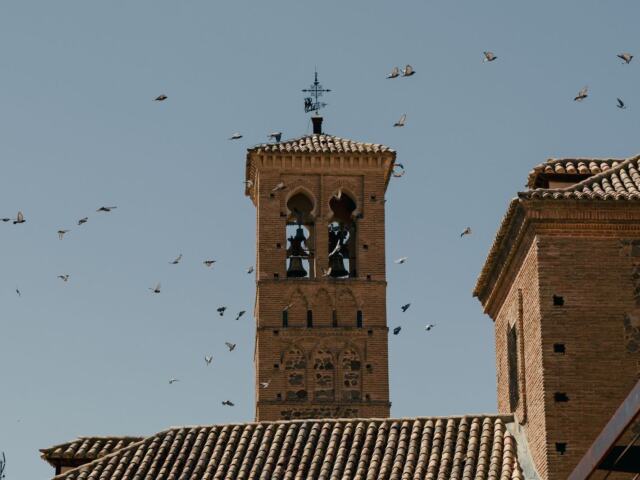
The Almohads built a strong kingdom centred at Seville from the 1100s until 1248. Few examples of their architecture survive, but it featured brick buildings with elaborate carved stone decoration and glazed coloured tiles.
Of the great Almohad mosque of Seville only the patio and minaret still stand, and the minaret is now the bell tower of Seville’s Christian cathedral. Scholastic adds that the style passed to the Christian conquerors as mudéjar art.
Granada and the Alhambra
The fall of Seville in 1248 left only the southeastern corner of Spain in Islamic hands. Even so, the Nasrid dynasty built a great kingdom at Granada, which lasted until its defeat by the Catholic monarchs Ferdinand and Isabella in 1492, as Scholastic recounts.
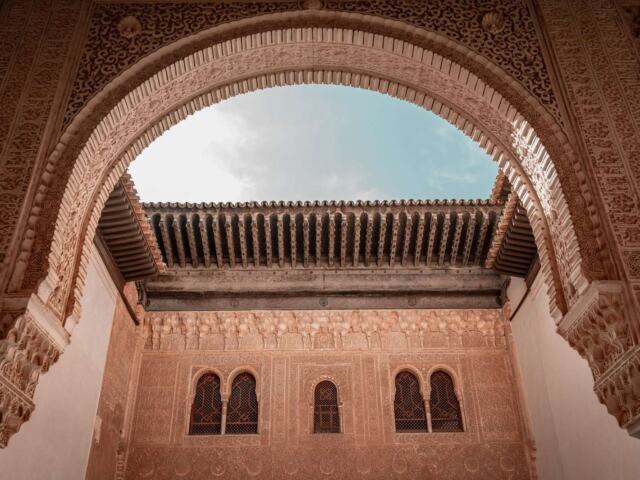
The Alhambra is a fortified palace with beautiful gardens. According to Sotheby’s Realty, it was built on a hillside overlooking Granada in the 13th and 14th centuries using arcades, exquisite vaulting and spatial symmetry.
The full story of the palace is told in the alhambra architecture history guide.
Mudéjar: a shared language
Wikipedia describes Mudéjar as a style found from the 12th to 16th centuries, blending Romanesque, Gothic and Renaissance architecture with constructive, ornamental and decorative motifs derived from those brought to or developed in Al-Andalus (source).
Seville’s Alcázar is the classic case: what many people think of as the most typically Moorish building in the city was largely built by Christian kings in the mudéjar style. The full picture is in the guide to mudejar architecture.
Romanesque and Gothic in the Christian kingdoms
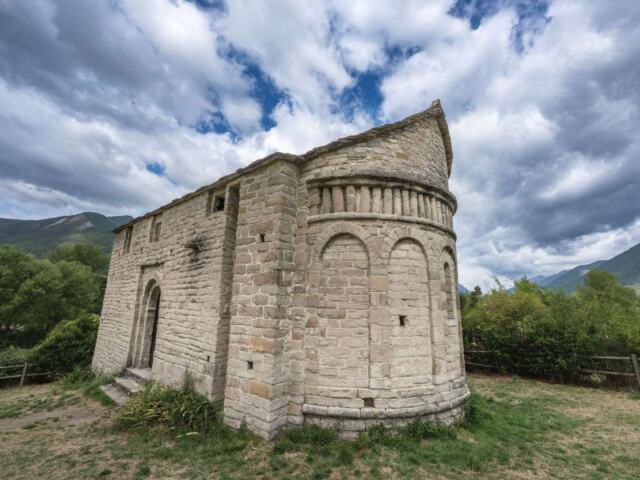
As Christianity took hold of Spain in the medieval era, Romanesque and Gothic became the primary design languages, according to the Sotheby’s guide. Fortress-like churches displayed faith in an authoritative way.
Wikipedia explains that kingdoms such as Castile and Aragon gradually emerged and developed their own styles, at first mostly isolated from other European influences. They were soon integrated into the Romanesque, Gothic and Renaissance streams. Early examples of the first style are collected in the guide to romanesque churches in spain.
How Gothic arrived
According to Wikipedia’s Spanish Gothic page, the style started in Spain through Central European influence in the twelfth century, when late Romanesque alternated with few expressions of pure Gothic. High Gothic arrived with full strength via the pilgrimage route, the Way of St. James, in the thirteenth century.
Early Spanish Gothic was largely a transitional style. Unlike its French cousin, which used large windows and monumental towers to emphasise light and verticality, it favoured fewer windows and sprawling horizontal floor plans.
The style coincided with the peak of the Reconquista, so some early Gothic churches also worked as defensive military structures. That is one reason they often lacked the ornamentation seen in France.
High Spanish Gothic drew heavily on the Rayonnant style of France, with large windows and intricate bar tracery. It still preferred horizontal plans over soaring towers, and it added lavish sculpture and Islamic-style geometric patterns.
Four cathedrals worth knowing
- Ávila: in 1172 French architect Giral Fruchel designed what Wikipedia calls the first Gothic cathedral in Spain. It blends Romanesque and Gothic and has a double ambulatory and radiating chapels.
- Toledo: in 1227 Archbishop Rodrigo Jimenez de Rada began its Gothic rebuilding. Its ground plan resembled that of a mosque, and its fusion of Islamic and French Gothic influences helped create a distinctively Spanish style.
- Burgos: begun in 1221, it has flying buttresses, clerestory windows, pier arches and a rose window. Its choir sits in the centre of the nave, and Sotheby’s Realty says it took its cues from the French blueprint.
- León: Wikipedia presents León Cathedral as a fine example of Gothic architecture in Spain.
A double ambulatory is an apse surrounded by two walkways, and radiating chapels are small semicircular chapels along the apse. Both features are described on the Spanish Gothic page.
Regional variations
In the fourteenth century Spanish builders began adding ornate features, and Catalonia was seen as superior for its frequent use of design elements. The Chapel of Santa Ágata in the Royal Palace of Barcelona, built from 1303 to 1310, shows double windows, polished contours and refined proportions.
Two later branches stand out: Levantine Gothic, marked by structural achievements and the unification of space, and Isabelline Gothic, which under the Catholic Monarchs predicated a slow transition to Renaissance architecture. Gothic construction ended in Spain in the sixteenth century.
Mudéjar craftsmen and Christian craftsmen influenced by them sometimes decorated Gothic buildings with Mudéjar elements. The same page says this created a highly distinctive Gothic style unique to Spain and Portugal.
Renaissance, Baroque and the empire overseas
Towards the end of the 15th century, Spain itself experimented with Renaissance architecture, developed mostly by local architects, says Wikipedia. That happened before Spain began influencing others with its colonial architecture.
The fall of Granada in 1492 ushered in a new political identity, per Sotheby’s Realty. Spain became an empire with vast territories in the Americas and Italy, where architecture could impose new ideas and legitimacy.
Herrera and the austere style
Renaissance design in Spain arrived in a more clinical and austere manner. Strict symmetry on the grandest scale joined the Herrerian style, named after Juan de Herrera, which rejected over-ornamentation in favour of rigour and power.
El Escorial, built near Madrid in the mid-to-late 16th century, was one of Herrera’s most notable projects. The guide describes a great basilica at the centre anchoring the whole structure, a design that whispers order rather than singing of spectacle.
Baroque and Neoclassicism
Spanish Baroque was distinguished by two things: exuberant Churrigueresque decoration and the more sober Herrerian style. Wikipedia says both developed separately from later international influences.
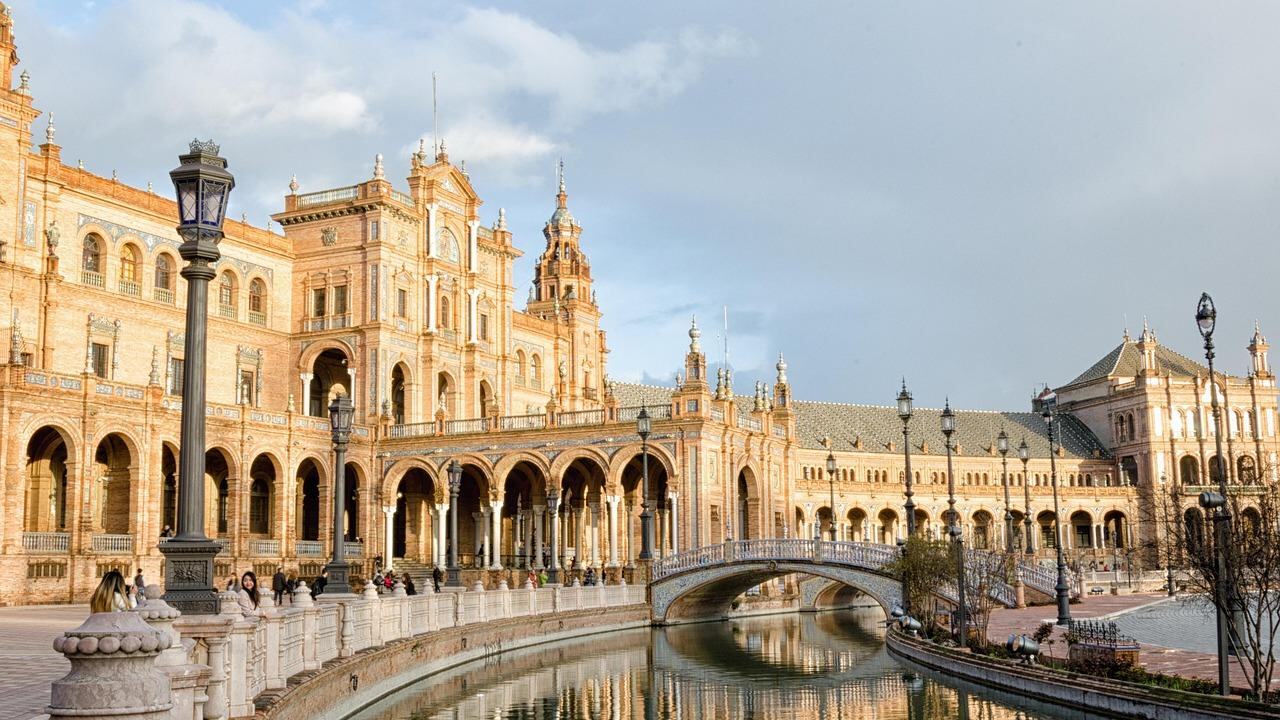
Neoclassicism reached its peak in the work of Juan de Villanueva and his disciples. Wikipedia’s list of Madrid and Seville landmarks, such as the Royal Palace of Madrid and Plaza de España in Seville, shows how varied the later styles became.
Colonial reach
The Colonial style, which has lasted for centuries, has a strong influence, according to Wikipedia, and Spanish architects worldwide influenced mainly areas that were once part of the Spanish Empire. Its contents list refers to Spanish Viceroyal architecture in America and the Pacific.
For how these ideas travelled, read about spanish colonial architecture.
Modernisme, modernity and the contemporary scene
The 19th century had two faces, in Wikipedia’s account. One was engineering effort that used iron and glass as the main building materials, and the other was academic focus on revivals and eclecticism, then regionalism.
The arrival of Modernisme in the academic arena produced figures such as Gaudí and much of the architecture of the 20th century. Wikipedia adds that the International style was led by groups like GATEPAC.
Gaudí and Catalan Modernisme
The Sotheby’s guide calls Modernisme a fusion of architecture, literature and art that supported the Catalonian boom at the turn of the 20th century. Barcelona expressed its status through commissioned buildings, and natural motifs looked to creation itself for inspiration.
Antoni Gaudí was at the forefront, and the Sagrada Familia is called Spain’s most famous building. Its catenary arches, hyperboloid vaults and branching columns make it feel organic, and hanging chain models were used to work out its load-bearing.
The same guide says more than 130 years have passed since construction began and the building is still evolving. Two pieces go deeper: gaudi buildings in barcelona and the wider story of catalan modernisme architecture.
Democracy, the Guggenheim and today’s names
Spain witnessed a transition to democracy at the end of the 20th century, and the built environment saw a new era of revitalisation, per Sotheby’s Realty.
The guide points to the titanium and glass curves of Frank Gehry’s Guggenheim in Bilbao, completed in 1997, as the clearest expression of these ideals. Gehry and his team used digital modelling software to translate initial sketches into achievable forms, a topic taken further in the piece on guggenheim museum bilbao architecture.
Wikipedia names Rafael Moneo, Santiago Calatrava and Ricardo Bofill among Spanish architects who have gained worldwide renown. It also says many sites in Spain, even portions of cities, have been designated World Heritage Sites by UNESCO, with Spain third in number behind Italy and China.
How can you read a Spanish building?
You can use a few visual clues to place a building in its era. Each clue below comes from the sources used in this guide.
- Horseshoe arch: introduced by Visigothic builders and later a basic element of Spanish architecture; it appears at Córdoba.
- Alternating colour in arch stones: a feature derived from the Roman aqueduct at Mérida and used in Córdoba’s Great Mosque.
- Brick with glazed coloured tiles: typical of Almohad work.
- Few windows and sprawling horizontal plans: a mark of Early Spanish Gothic, unlike the vertical French model.
- Islamic-style geometric patterns on Gothic sculpture: a sign of High Spanish Gothic.
- Strict symmetry and little ornament: the Herrerian style of El Escorial.
- Catenary arches and branching columns: Gaudí’s Sagrada Familia.
Sotheby’s Realty closes by saying Spanish architecture tells the story of repeated reinvention, with refined mathematics, frequent returns to nature and exploration of divinity recurring across the timeline.
If this vocabulary is new to you, start with architecture basics for the key terms. The same ideas of light, proportion and materials also appear in home design principles.
Frequently asked questions
What counts as Spanish architecture?
Show answer
Per Wikipedia, it covers any area of what is now Spain, plus work by Spanish architects worldwide, including buildings from before Spain existed as a nation.
Which Roman monument in Spain is most often cited?
Show answer
The Aqueduct of Segovia, built in the first century CE, is highlighted by Sotheby’s Realty for its 167 arches of precision-cut granite blocks.
What is Mudéjar architecture?
Show answer
It is a style that blends Romanesque, Gothic and Renaissance architecture with motifs derived from Al-Andalus. Wikipedia dates it from the 12th to 16th centuries.
Which modern architects are named for worldwide renown?
Show answer
Wikipedia names Rafael Moneo, Santiago Calatrava and Ricardo Bofill, alongside Gaudí for Modernisme. Sotheby’s Realty credits Frank Gehry with the Guggenheim in Bilbao, completed in 1997.
How does Spain rank for World Heritage Sites?
Show answer
Wikipedia says Spain has the third highest number of World Heritage Sites in the world, with only Italy and China having more. Its page carried a citations notice dated April 2022, so check UNESCO’s own list for the latest count.